

What Being Human Means
what to avoid - what to embrace

I’m waiting to see if I am human - or not!
Here’s what happened:
I belong to several forums and organizations that have articles and presentations on topics that interest me - spirituality, philosophy, psychology, cosmology, etc.
Some of these send out e-mails that summarize what the current topics and offerings are.
If these “teaser” articles are of interest, there is usually a link that one can “click on” and be taken to the website where the full article is published.
The other day one caught my interest and I clicked on the link to the full article. What came up was a page that said, “Click here if you are not a robot.” Although I can be mindless and live robot-like, I’m not a robot.
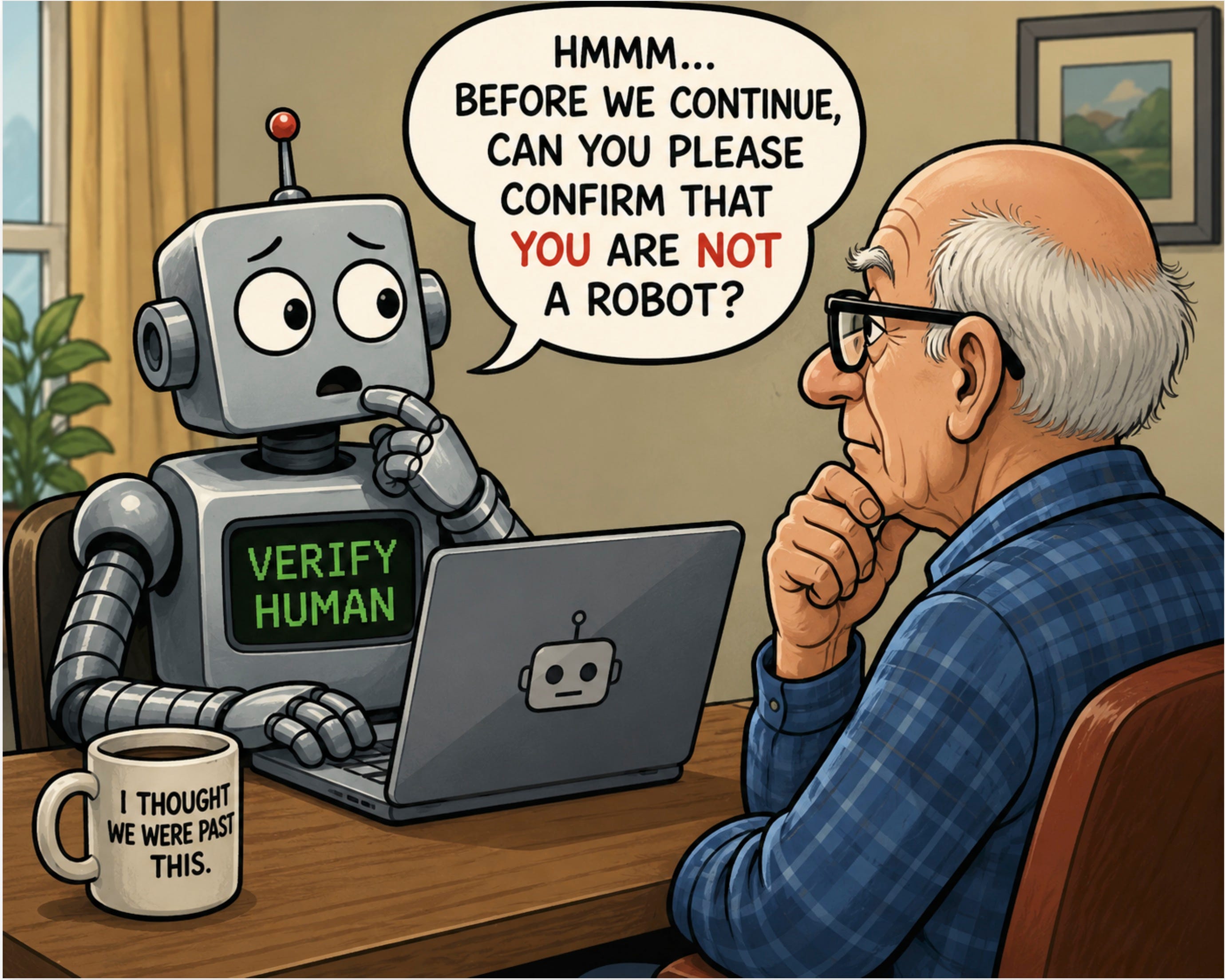
I’ve encountered this sort of thing before. It has always struck me as somewhat funny that a robot is asking me if I’m a robot. I clicked on it and up came a page that said, “Be patient while we determine if you are a human.”
I was patient.
I waited.
And, waited.
I busied myself with other matters on my desk while it was trying to determine if I met the criteria - whatever they might be - that would qualify me as a human.
After about ten minutes I thought, “This is ridiculous” and moved on to other matters.
As far as I know there is still a bot out there is cyberspace trying to determine if I am worthy of its time and attention; trying to determine if I am human.
My work, both personal and professional, has for decades been trying to learn, know and teach what it means to “be fully human.”
During this time, I’ve learned that becoming fully human is a life-long process. Every time I have thought that I had a firm grasp on the matter, I soon came to realize that I had simply reached another rung on the never-ending ladder of awareness. Or, to use another metaphor, I seem to come, over and over again, to a place in the journey that invites me to take another leap in the open future.
When I was first introduced to the notion of existentialism, one teacher explained it to me this way:
you can either stand on a balcony watching the parade below go by; or, you can be part of the parade.
Being human is being a participant in life rather than an observer.
My experience as a spiritual teacher is that everyone, if they are honest - and such honesty is no simple or easy task - knows whether she or he is on the shore watching the waves or whether that person is in the swim of things.
In a recent brilliant presentation I heard her make, Dr. Holly Hudley quoted Alan Lightman:
“Being alive at all is the most extraordinary stroke of good luck any of us will ever experience.”
Sadly, many people do not actually experience “being alive.”
Why is that?
Much of the world’s population, of course, is caught in the oppressive prison of a poverty that no one reading these words knows. For those of us fortunate enough to have escaped that, we still can fall into “ways of being” that are prevalent in Western culture.
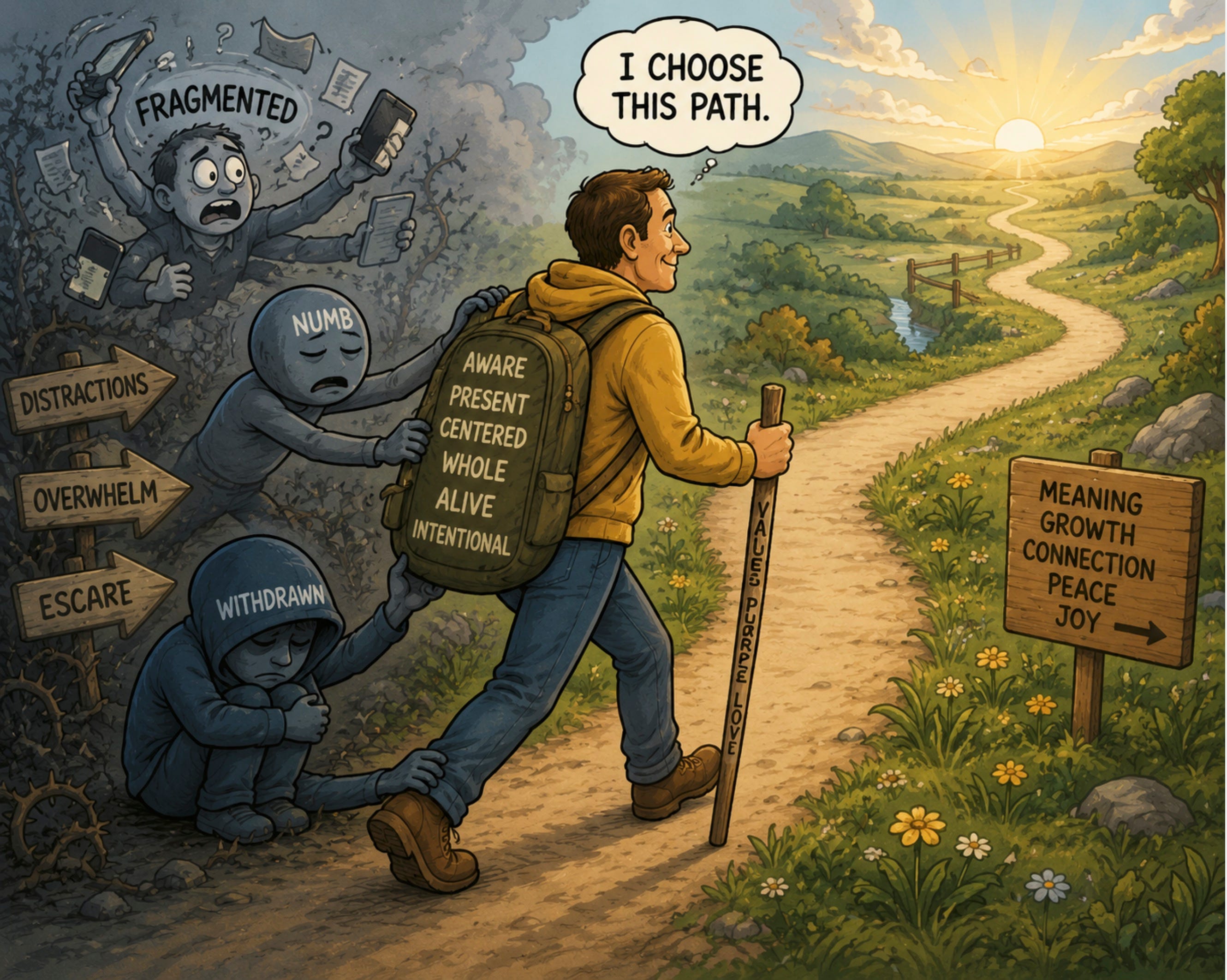
One of these is withdrawal. It is so easy simply not to be present.
In my teaching I harp on the importance of having “a daily spiritual practice.” Some people are quick to tell me that they are “spiritual but not religious.” One response I have to that is, “Terrific. Tell me, how do you practice being spiritual? What does that consist of for you?”
What follows is frequently an awkward silence.
Being present is difficult.
When people ask for guidance in having a meditation practice, the very first thing I tell them is that they should be prepared to experience what a horrible failure they will be at it. Try it for yourself and see. Try silently counting ten breaths with not one single interrupting thought. It is very difficult. (Actually it is impossible for all but a dedicated few!) What some practitioners refer to as “monkey mind” causes us mentally to jump all over the place.
It is also easy in the Western culture to experience fragmentation.
Unlike just a few generations ago, it is now possible for many of us to work in one place, live in another, and vacate to someplace else. That’s just in the outer world.
Our inner worlds are usually even more fragmented - or chaotic.
When I first began to receive training in Jungian dream analysis, I became acutely aware of not only the reality of the inner world but also the importance of acknowledging the denied and repressed aspects of ourselves. Carl Jung referred to these as the “shadow” aspects of our personality. Their power to run, rule and ruin our lives is incredible. My definition of the unconscious is simple:
“We don’t know what we don’t know.” Yet, what we “don’t know” often makes tremendous decisions for us.
The street term for the opposite of fragmentation is “getting your sh#*”together. Ironically most of us think we have accomplished this when our verbal and nonverbal behavior shows just the opposite.
Then, there is numbing.
I am not on any social media. I do have the Facebook app on my phone and for some reason the other day I accidentally tapped it. I noticed an item at the bottom of the page that simply said “reels.”
“What is that?” I wondered.
For the next twenty minutes I was gone - sucked up into the world of standup comedians, magic performances, and punsters. How did it know!?
It is so easy in this culture to get hooked and taken away - taken away from the moment, from others, from ourselves.
I’ve long believed that ours is a very addicted culture. We are, for one thing, addicted to violence. That, however, is a topic for another occasion.
Addiction to our devices - phones, tablets, etc. - is so widespread that hardly anyone denies the reality of this any more. Social psychologist Jonathan Haidt put it well:
“The phone-based life makes it difficult for people to be fully present with others when they are with others, and to sit silently with themselves when they are alone.”
Substance usage and process addictions - to our phones, gambling, sex, etc. - are incredible impediments to the experience of being fully human.
One of the ways I have been extremely luckily in the living of my life is to have encountered early on some very important, powerful, and influential teachers. One tasked me with defining or describing what I thought being fully human was. This was decades ago and the phrase I came up with was this:
To be human is to be involved in the process of becoming centers of freedom and love.
Each word is fraught with meaning:
“Involved” rather than an observer.
“Process” rather than a steady state. Growth in an imperative calling for the authentic human.
“Becoming” rather than allowing our identity to be define by what we do, have, or who we know.
“Centers” rather than being fragmented, divided, split, unknown to ourselves.
“Freedom” rather than trapped by addictions or roles.
“Love” - the capacity to have empathy for others and to treat others as the way we want to be treated.
I suppose that bot is still trying to figure out if I am human. Let it do its thing.
For me being human is not being waylaid by being fragmented, withdrawn and numb. It is- experienced and expressed by being involved in the process of being a center of freedom and love.
Thank goodness, this is a never-ending opportunity!
There are few life tasks more important than be able to answer the question, “Who am?”
Since my orientation is that of Jungian psychology with the particular religious language I was given to speak, my current answer is:
I am Sacred Mystery experiencing my particular, unique life on a this planet at this time.
Who are you?
Don’t allow some bot to decide the matter for you.
This was sent to me by a friend, I am heading to Spain to walk the Camino…perfect timing. Thank you
I needed this today. Thank you Bill.