

Golden Threads
How we got from there to here and guidance for what is next.

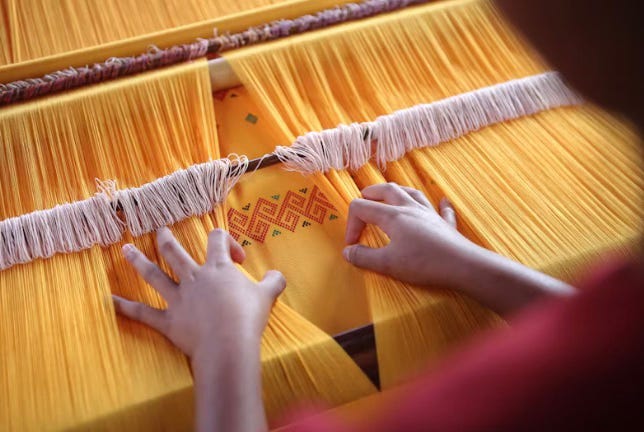
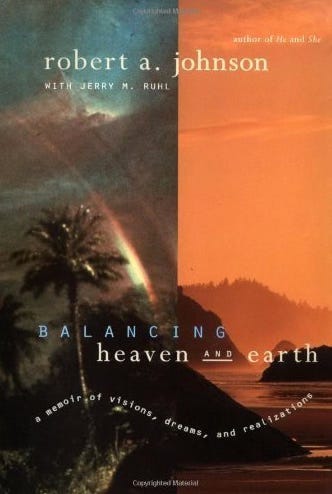
I got the phrase “golden threads” from Jungian author Robert Johnson. He meant by the phrase that our lives are guided and shaped by unseen forces. In his wonderful memoir, Balancing Heaven and Earth, he writes:
“One’s existence is somehow inspired, guided, and even managed by unseen forces outside our control. Whether called fate, destiny, or the hand of God, slender threads are at work bringing coherence and continuity to our lives. Over time they weave a remarkable tapestry.”
Each one of us has experienced such. Seemingly chance occurrences like getting ready to call a friend you haven’t spoken to in years and as you pick up the phone to make the call, it rings and it is that friend is an example. Being in the right place at the right time, meeting someone unexpectedly, some sudden inspiration - all of these contribute to our life’s journey.
I got a practical introduction to this when I did some study with Jungian analyst Ira Progoff and he had us write down the ten steps that got us from the day of our birth to where we currently were. I can look back from where I am sitting writing this and see the discrete events that, had they not happened, I would not be here. Some of these things at the time I labeled “bad” or even “tragic.” However, had it not been for them I would not be where I am today.
I encourage you to try the exercise. Get a piece of paper and write down a list beginning with “I was born” and, using no more than nine items, write down the events, people, ideas, etc. that had to occur for you to be where you are today. (My experience is that this list changes from time to time when I have done it.)
Robert Johnson used the phrase “golden threads” to describe the connective pattern that gives meaning to our lived experience.
What prompted this musing is that earlier today I finished reading yet another book by one of my favorite spiritual writers, Diamuid O’Murchu’s “Divine Radiance in Evolution.” I have read many of his books and got to thinking as I finished this one, “How did I first discover him?” This was prompted by my reading through the books he cites in the book I just finished for what else I might find of interest and nurture. (I found at least two!)
I have really enjoyed having a break from teaching this month of August.
AND, I am looking forward to resuming on September 7.
Both are true.
A number of people have been working “behind the scenes” to bring an entirely new look to Ordinary Life by this date. I am grateful to and for them.
I have used some of this time preparing for a day long event that will be held at the Jung Center in Houston on Friday, September 26.
The title of this day-long workshop with be “The Power of Conscious Choice” and I will be joined by my colleague and program director of the Jung Center in Houston, Brooke Summers-Perry. Brooke is, among her many other qualifications, a certified spiritual director and will be leading the experiential aspect of this workshop. Those of you who have experienced her teachings before know how powerful, insightful, and creative she is.
I’ll be using Progoff’s “Stepping Stone” exercise as part of this workshop.
When I entered clinical training in 1966 we were assigned two books to read. One was “Man’s Search for Meaning” by Viktor Frankl. The book was first published in 1946 and the German edition carried the subtitle: “”Say Yes to Life: A Psychologist Experiences the Concentration Camp.” The book is still cited, by those who do such rankings, as one of the most influential and important books ever written.
Frankl observed that among his fellow inmates in the concentration camp, those who survived were able to connect with a purpose in life to feel positive about and who, then, immersed themselves in imagining that purpose in their own way. According to Frankl, the way a prisoner imagined the future affected that prison’s longevity. The most famous line in the book is this:
“Everything can be taken from a person but one thing: the last of the human freedoms - to choose one’s attitude in any given set of circumstances, to choose one’s own way.”
If you have not read this book, do so. (Excuse his sexist language.)
What he has to say speaks to our current climate of fear and intimidation that are part of our current culture war. The book also underscores the HUGE unwillingness for any of our so-called “leaders” to show a willingness to take personal responsibility for virtually anything.
I would never have come to Houston had I not been fired from a teaching position I assumed would be my life’s vocation. Though it felt, and was!, tragic at the time; it was one of the stepping stones that led me to where I am today, preparing to teach such a seminar and living out my vocation as a spiritual teacher.
There are lines from the Bagavad Gita that are part of my daily practice. I recommend them to you
“Look to this day, for it is life, the very life of life.
In its brief course lie all the verities and realities of your existence:
The bliss of growth, the glory of action, the splendor of beauty.
For yesterday is but a dream, and tomorrow is only a vision;
But today well lived makes every yesterday a dream of happiness,
And every tomorrow a vision of hope.
Look well therefore to this day.
Such is the salutation of the dawn.”
This is the way we weave the tapestry of our lives.
So, no matter where you go, no matter what happens, remember this: you carry precious cargo. So, watch your step.
Love the suggested "Ten Steps" exercise. Going to allocate some time to do it in the next 2 days.